 Menu


For Joe Gillam, co-founder of London-based office design and build company Soul Spaces, a great workplace is about far more than desks, meeting rooms and square footage. It is about creating an environment where people can do their best work, collaborate effectively and genuinely want to spend time.
With eight years of industry experience, including five as managing director of one of London’s fastest-growing construction teams, Joe has worked with businesses including Red Bull, Badoo and Methods. His experience has helped shape a practical, people-first approach to workplace design, balancing ambitious ideas with the realities of budgets, business needs and the way teams work today.
At Soul Spaces, the team works with businesses across London to deliver office design and build fit-outs, supporting clients from their initial brief through to handover. The company also helps businesses navigate the process of finding the right workspace, with free lease negotiation included as part of its service.

In his latest thinking on London workplace trends for 2026, Joe identifies three priorities shaping the next generation of offices: more intelligent meeting spaces, interiors with warmth and texture, and workplaces that give businesses a genuine advantage in attracting and retaining talent.
We sat down with Joe to explore what these trends mean for businesses and why getting the workplace right has never been more important.
The Interview
Q: For those who might not know Soul Spaces, can you tell us a little about the company and what you do?
Gillam: Soul Spaces is an office design and build company working with businesses across London. We help companies create workplaces that reflect who they are, support their teams and make sense for the way they operate.
Our work covers the journey from the initial brief through to the completed fit-out. We want to understand what a business is trying to achieve, how its people work and what the space needs to deliver, rather than simply designing something that looks good.
Ultimately, we believe an office should be an investment in people. When a workplace is thoughtfully designed, it can become a platform for a team to thrive.
Q: You’ve identified three major workplace trends for London in 2026. What are you seeing in the market?
Gillam: We’re seeing businesses become much more considered about where they invest their fit-out budgets. They want to understand what will genuinely improve the workplace experience, rather than spending money for the sake of appearances.
Three things are coming up consistently. First, businesses are rethinking meeting rooms to better reflect how people actually work. Second, there’s a growing appreciation for texture, warmth and materials that make an office feel welcoming. And third, companies are recognising that the workplace can play an important role in attracting and retaining good people.
What connects all three is that design needs to serve a purpose. It should solve problems, improve the day-to-day experience and contribute to the wider business.
Q: Let’s start with meeting rooms. Why do you think their design needs to change?
Gillam: A lot of offices were designed around a very different way of working. Now, you might have one person sitting in a boardroom designed for eight, while a team of six is struggling to find somewhere suitable for a video call.
The answer isn’t necessarily to build more traditional meeting rooms. It’s to look at the conversations and activities happening throughout the day and design spaces around those needs.
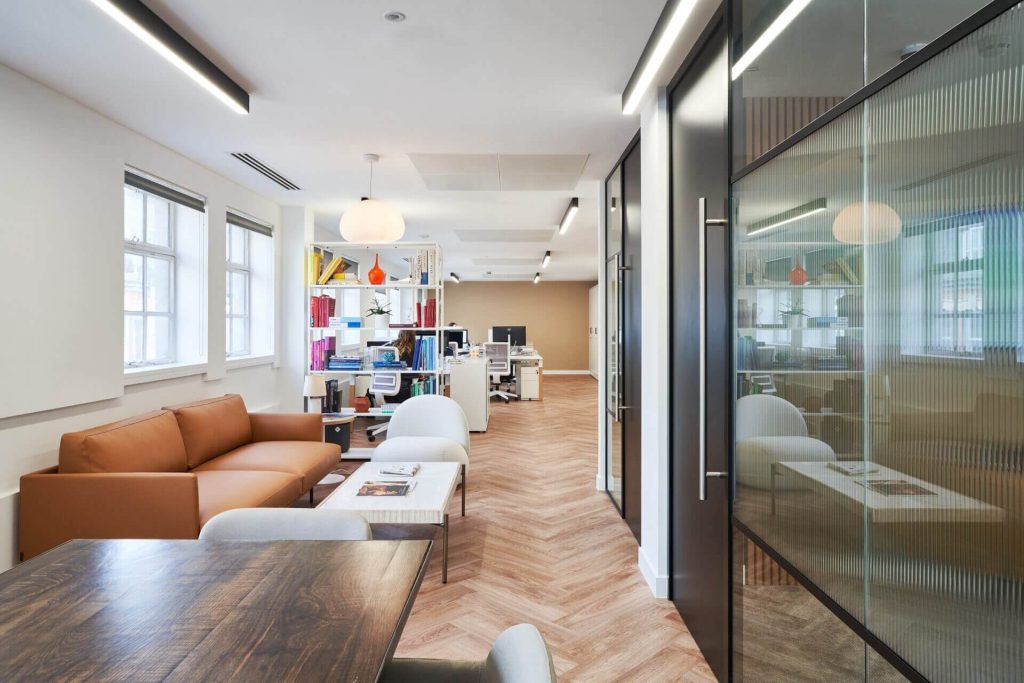
Inset: an office in Soho designed by Soul Space
Acoustic booths are a good example. They give people somewhere to take calls privately without occupying a large meeting room or requiring the cost of a full partitioned space. They can make a meaningful difference without demanding a huge budget.
We’re increasingly seeing them as a fundamental part of a well-planned office, rather than an optional extra.
Q: Beyond functionality, you’ve highlighted texture as a defining feature of good office design. Why does it matter so much?
Gillam:: It’s easy to underestimate the effect that materials and finishes have on how a space feels. An office can have all the right furniture and equipment but still feel clinical if every surface is smooth, uniform and lacking in character.
Texture creates depth. It gives a space warmth and makes it more interesting to spend time in. That might come from rugs, curtains, plants, artwork or finishes such as limewash paint.
These elements don’t have to be extravagant, and you don’t need to introduce all of them into every room. The important thing is to create contrast and give the interior a more natural, considered feel.
Good design is about more than what a space looks like in a photograph. It’s about how it feels to be there every day.
Q: Is this a sign that businesses are moving away from the minimalist, corporate office?
Gillam: I think businesses are becoming more thoughtful about what makes an office work. Minimalism can be effective, but there’s a difference between a clean, considered environment and a space that feels empty or impersonal.
People want workplaces that feel comfortable, engaging and connected to the identity of the business. That doesn’t mean every office needs to be bold or unconventional. It means making deliberate choices about materials, lighting, furniture and how the space is used.
The best environments balance functionality with character. They feel professional without feeling sterile.
Q: Your third trend is the office as a tool for attracting and retaining talent. How has that changed the way businesses approach their workspace?
Gillam: For a while, there was a genuine question about whether an office needed to be anything more than a functional place to work. What we’re seeing now is businesses recognising the value of the workplace as part of their wider proposition to employees.
That doesn’t mean working against flexible or hybrid arrangements. It means giving people compelling reasons to come together when being in the same space adds value.
The quality of the environment matters. Natural light, comfortable breakout areas, reliable technology, good coffee and access to private spaces for calls can all contribute to a better experience.
Businesses are also becoming more ambitious about creating offices they’re proud to show clients, prospective employees and their own teams. A workplace can communicate a lot about a company’s culture and values.
Q: With budgets always a consideration, where would you advise a business to invest first?
Gillam: Start by understanding the problems you need to solve. Before committing to a design, look at how the existing space is being used, where the frustrations are and what employees need to work effectively.
From there, focus on the things that make a tangible difference. Acoustic booths can address call-space issues. Better AV and IT infrastructure can make collaboration less frustrating. Natural light and well-configured breakout areas can improve the overall experience.
Even relatively simple things, such as providing quality coffee and filtered water, can help make the office a more pleasant place to spend time.
I wouldn’t advocate spending money on decorative features simply because they look impressive. The best investments are the ones that improve the way people experience the space and support the business’s objectives.
Q: How do you balance creating an inspiring workplace with the practical realities of a fit-out?
Gillam: It comes down to understanding the brief properly. You need to know what the business wants to achieve, what its budget is and how the space will be used. Without that understanding, it’s easy to create something visually impressive that doesn’t work particularly well in practice.
Design, construction and day-to-day functionality all need to come together. A beautiful office that doesn’t have enough private call space, or where the technology doesn’t work reliably, hasn’t really delivered.
Our approach is to look at the whole picture. The aim is to make the investment work as hard as possible, both in terms of the finished environment and the people who use it.
Q: What’s your biggest piece of advice for a business planning a new office or refurbishment in 2026?
Gillam: Don’t start with what you think an office should look like. Start with what you need it to do.
Think about how your team collaborates, where people need privacy, what makes them want to come into the office and what impression you want to give clients and prospective employees.
Then prioritise the investment around those needs. You don’t necessarily need the biggest fit-out or the most expensive finishes to create an excellent workplace. You need a clear brief and a design that responds to it.
A successful office should feel right for the business, work well for its people and continue to deliver value long after the fit-out is complete.
Q: Finally, what does the future of the London workplace look like to you?
Gillam: I think we’ll continue to see businesses move towards more purposeful workplaces. Every element should have a reason for being there, whether that’s a meeting room designed for collaboration, a booth for focused calls or a breakout area that encourages people to spend time together.
At the same time, I expect businesses to keep investing in the character and quality of their spaces. The office needs to offer something beyond a desk and a chair.
For us at Soul Spaces, the opportunity is to help businesses bring those things together: a space that works practically, feels great to be in and gives people the environment they need to prosper.

 0 comments
 Share


